

Confused about your eligibility? Get a free profile check in under 2 minutes.
Check My Eligibility →
What are you looking for?
Pick one to get started.
Where & what to study?
Select country and program type.
Which language interests you?
Pick one or more.
Which exam are you preparing for?
Select all that apply.
Which services do you need?
Select all that apply.
Your academic background
Helps us find the best match for you.
How do we reach you?
100% confidential — never shared.
Review & Submit
Everything look good?
Our mentor will contact you within 24 hours.
Check your email for confirmation.
By submitting you agree to our Privacy Policy.
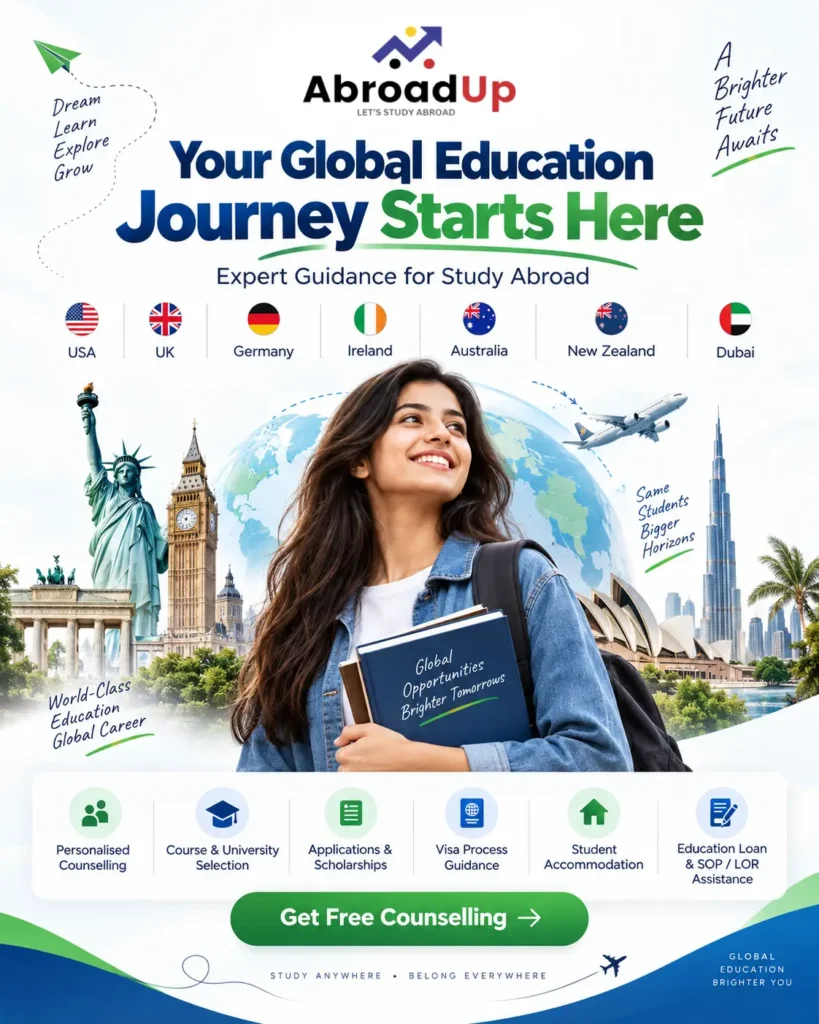
To study in Asia, you can choose from destinations as different as Singapore, Malaysia, Japan, South Korea, Hong Kong, China and the UAE, with yearly tuition starting at about US$3,000 in the lower-cost options and a flight home of only 3 to 8 hours. A realistic budget is about US$8,000 to US$35,000 a year including living costs, depending on the country and course. Asia is not one market, so the real task is matching a country to your budget, language and career plan. This guide compares the most popular Asian study destinations for Indian students and explains costs, exams, visas, work rules and life after graduation in plain terms.
Indian students choose to study in Asia for lower costs, a short trip home and universities that rank among the best in the world. Several Asian institutions regularly appear in the global top 20, and the region is home to fast-growing technology, manufacturing, finance and trade sectors. Living close to India also means easier family visits, familiar food in most big cities and less culture shock than a move across the world.
The region also gives you unusual variety. You can study in English in Singapore, Hong Kong or Malaysia, learn a new language and culture in Japan or Korea, or pick a branch campus of a British or Indian university in the UAE. Asia's economies keep growing, so many graduates find work that connects them back to India and other emerging markets.
Be careful with one thing: cheap does not always mean good value. Check accreditation, teaching language and post-study options for each country. If cost is your main concern, also compare our budget friendly degree options and the Study Free In Germany guide before you decide.
There is no single best country. These seven are the most common choices, each with a different strength:
| Country | Approx. Yearly Tuition | Main Intake | Teaching Language |
|---|---|---|---|
| Singapore | US$13,000 to US$17,000 with a Tuition Grant, more without | August | English |
| Malaysia | US$3,000 to US$10,000 | February and September | English |
| Japan | US$3,500 to US$10,000 | April, some in October | Japanese or English |
| South Korea | US$3,000 to US$9,000 | March and September | Korean or English |
| Hong Kong | US$15,000 to US$25,000 | September | English |
| China | US$3,000 to US$8,000, more for some programmes | September | Chinese or English |
| UAE | US$11,000 to US$25,000 | September and January | English |
These figures are approximate and change with exchange rates, university, course and year. Always confirm current fees on the official university website.
The systems differ, so do not assume that one rule fits every country. Singapore, Hong Kong and Malaysia follow British-style structures, with 3 to 4 year bachelor's degrees and 1 to 2 year master's programmes. Japan and Korea follow 4-year bachelor's degrees and 2-year master's programmes, with a strong research culture. China uses 4-year bachelor's degrees and 2 to 3 year master's programmes. In the UAE, many campuses award UK, Australian or Indian degrees under the home university's rules.
Some countries also offer twinning or joint programmes, where you spend part of your degree in Asia and part in another country, such as the UK or Australia. These can reduce total cost, but check that the final degree is awarded by the foreign university and recognised where you plan to work.
| University | Known For | Country |
|---|---|---|
| National University of Singapore (NUS) | Engineering, Computing, Business, Medicine | Singapore |
| University of Hong Kong (HKU) | Medicine, Law, Sciences, Business | Hong Kong |
| Universiti Malaya | Engineering, Sciences, Business | Malaysia |
| University of Tokyo | Sciences, Engineering, Research | Japan |
| Seoul National University | Engineering, Sciences, Business | South Korea |
| Tsinghua University | Engineering, Technology, Sciences | China |
| BITS Pilani Dubai Campus | Engineering, Computer Science, Sciences | UAE |
Visit our Asia destination page for intake calendars, programme lists and partner institutions in one place.
Most Indian students spend between US$8,000 and US$35,000 a year, tuition and living costs together. Malaysia, China, Japan and Korea sit at the lower end. Singapore, Hong Kong and the UAE sit at the higher end. Use the table below as a general range and check exact costs in the country you choose.
| Expense | Approximate Cost (per year) |
|---|---|
| Tuition | US$3,000 to US$25,000 |
| Accommodation | US$2,500 to US$10,000 |
| Food, transport and personal costs | US$2,000 to US$5,000 |
| Health insurance | US$200 to US$800 |
| Proof of funds for the visa | Depends on the country and course |
Scholarships can cut costs a lot. Examples include the Japanese government (MEXT) scholarship, the Global Korea Scholarship, the Chinese Government Scholarship, PhD awards in Singapore and university merit awards across the region. Most are competitive, and rules change every year, so check each programme's page.
Our services team can help you compare education loans and prepare the financial documents that embassies ask for.
If you plan to learn a new language, start early. Our language courses page shows what training is currently offered, and our exam preparation courses help you plan the English test score you need.
Intakes vary by country. Japan starts mainly in April, Korea in March and September, Singapore in August, and Hong Kong, China and the UAE mostly in September. Malaysia offers intakes in February and September, with some private campuses admitting several times a year. Application deadlines can fall 6 to 12 months before your start date, especially for scholarships, so start your research at least a year ahead.
Start your Asia application the right way, talk to a mentor today.
Book Free Counselling →Each country has its own process, and most start with a university offer. In many cases the university plays a big role in the filing:
Common documents include your admission letter, proof of funds, passport, photos and health insurance. Rules, fees and processing times change often, so confirm the latest steps on each country's official website before you pay.
If you want your file checked before you submit, our visa support team can review your documents and point out gaps early.
Work rules are stricter in most Asian countries than in the UK or Canada, and they differ a lot:
Post-study options change often, so treat them as opportunities, not guarantees, and check the latest conditions before you plan your finances.
Malaysia, China, Japan and South Korea are usually the most affordable, with yearly tuition starting at about US$3,000. Singapore, Hong Kong and the UAE cost more.
Singapore, Hong Kong, Malaysia and the UAE teach mainly in English. Japan, Korea and China also have English-taught programmes, but the choice is smaller.
It depends on the country. September is the main intake in Hong Kong, China and the UAE, August in Singapore, and April in Japan. Korea and Malaysia offer more than one main intake.
Usually yes, but with limits. Singapore allows up to 16 hours a week in term at approved institutions, and Japan allows up to about 28 hours with permission. Rules differ by country, so check the current conditions.
Some countries offer job-hunting stays or work passes, but there is no common rule. Options vary and change often, so check each country's current conditions before you plan around them.
Many are, but recognition depends on the university, the programme and your plans in India. Check equivalence with the Association of Indian Universities before you enrol if you plan to study further or apply for a government job in India.
Often yes, especially in Malaysia, China, Japan and Korea, though Singapore, Hong Kong and the UAE can cost as much as some European countries. Compare the details on our Europe destination page and USA destination page before you decide.
Takes under a minute · No cost, no obligation



AbroadUp is an innovative study abroad consultancy with its Head Office at Pitampura, Rohini, Delhi. With its “Student First” approach, AbroadUp and its experienced mentors hand-hold and guide students towards diverse range of study abroad programs, curated internships, affordable countries, and global opportunities.
Germany, France, Italy, Austria, Belgium, Bulgaria, Croatia, Cyprus, Czech Republic, Denmark, Finland, Georgia, Greece, Hungary, Latvia, Lithuania, Malta, Netherland, Poland, Portugal, Romania, Spain, Sweden, Swizerland, Russia, Monaco, Norway
UAE/Dubai, Japan, South Korea, China, India, Indonesia, Malaysia, Mauritius, SriLanka, Thailand, Vietnam, Taiwan
Vietnam Tour Package | Vietnam Tour Package in Florida | Vietnam Tour Package in New York | Vietnam Tour Package in California Uzbekistan Tour Package | Uzbekistan Tour Package in Florida | Uzbekistan Tour Package in New York | Uzbekistan Tour Package in California Sri Lanka Tour Package | Sri Lanka Tour Packages in Florida | Sri Lanka Tour Package in New York | Sri Lanka Tour Packages in California Philippines Tour Package | Philippines Tour Package in Florida | Philippines Tour Package in New York | Philippines Tour Package in California Nepal and Bhutan Tour Package | Nepal and Bhutan Tour Package in Florida | Nepal and Bhutan Tour Package in California | Nepal and Bhutan Tour Package in New York Laos Tour Package | Laos Tour Packages in Florida | Laos Tour Packages in California | Laos Tour Package in New York India Tour Package | India Tour Package in California | India Tour Package in Florida | India Tour Package in New YorkBangladesh Tour Package | Bangladesh Tour Package in California | Bangladesh Tour Package in Florida | Bangladesh Tour Package in New YorkAfghanistan Tour Package | Afghanistan Tour Package in California | Afghanistan Tour Package in Florida | Afghanistan Tour Package in New YorkAzerbaijan Tour Package | Azerbaijan Tour Package in Florida | Azerbaijan Tour Package in California | Azerbaijan Tour Package in New York Egypt Tour Package | Egypt Tour Package in New York | Egypt Tour Package in Florida | Egypt Tour Package in California Oman Tour Package | Oman Tour Package in California | Oman Tour Package in New York | Oman Tour Package in FloridaIraq Tour Package | Iraq Tour Package in California | Iraq Tour Package in Florida | Iraq Tour Package in New York Algeria Tour Package | Algeria Tour Package in Florida | Algeria Tour Package in California | Algeria Tour Package in New York
©2026 AbroadUp™ Owned by Skillingua Global Pvt. Ltd.