

Confused about your eligibility? Get a free profile check in under 2 minutes.
Check My Eligibility →
What are you looking for?
Pick one to get started.
Where & what to study?
Select country and program type.
Which language interests you?
Pick one or more.
Which exam are you preparing for?
Select all that apply.
Which services do you need?
Select all that apply.
Your academic background
Helps us find the best match for you.
How do we reach you?
100% confidential — never shared.
Review & Submit
Everything look good?
Our mentor will contact you within 24 hours.
Check your email for confirmation.
By submitting you agree to our Privacy Policy.
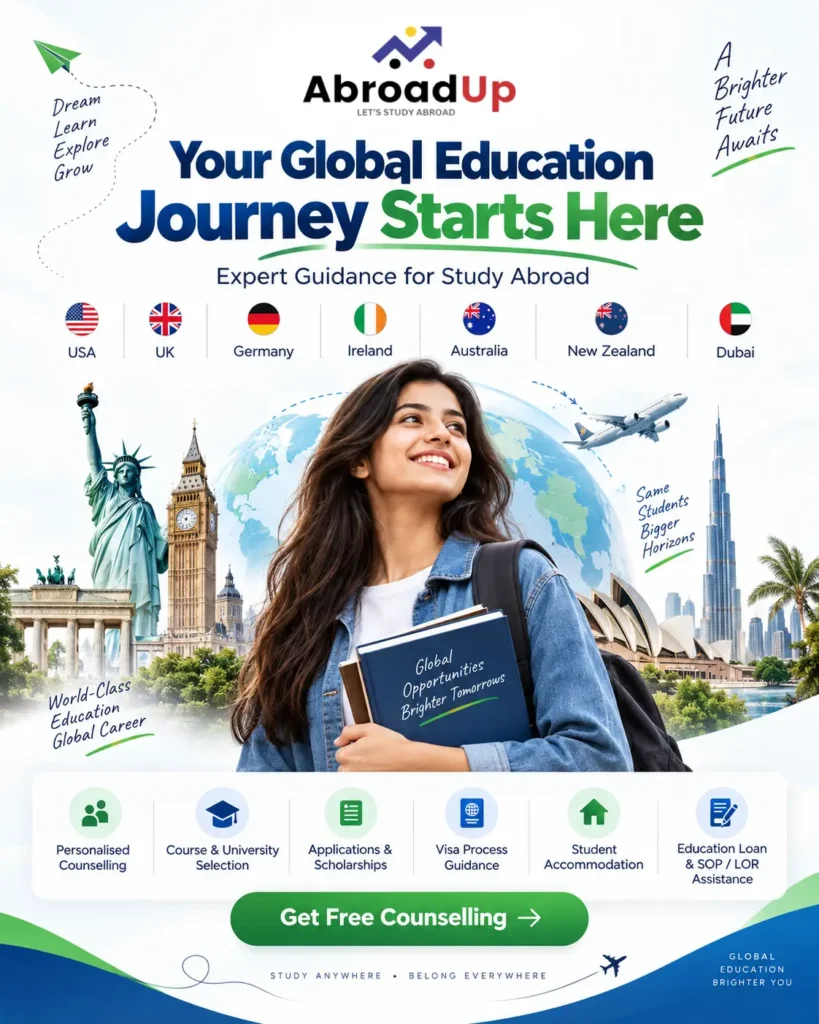
The IELTS exam (International English Language Testing System) is a four-part English test that measures your listening, reading, writing and speaking skills on a band scale from 0 to 9. Universities, employers and immigration departments in countries such as the UK, Canada, Australia, New Zealand and Germany accept the IELTS exam as proof of English ability. Most students need an overall IELTS band score between 6.0 and 7.0 for a degree abroad. This guide explains the IELTS exam pattern, fees, registration, scoring and IELTS preparation in plain terms, so you can plan your test with confidence.
The IELTS exam is a standardised English test owned jointly by the British Council, IDP Education and Cambridge University Press and Assessment. It is one of the most widely accepted English tests in the world, recognised by thousands of universities, employers and government bodies. If you plan to study, work or migrate to an English-speaking country, there is a good chance you will need an IELTS band score.
There is no pass or fail in the IELTS exam. You receive a score for each skill and an overall band, and each university or visa authority decides what number it needs. That is why the first step in any IELTS preparation plan is to check the score your target course asks for. Our exam preparation page explains how we help students plan this step.
There are two main versions of the IELTS exam. Listening and Speaking are the same in both, but Reading and Writing differ. Choosing the wrong version is a costly mistake, because the result may not be accepted for your purpose.
| Feature | IELTS Academic | IELTS General Training |
|---|---|---|
| Best for | Bachelor's, master's and PhD admission, and professional registration | Work experience, training programmes and migration to some countries |
| Reading | Long passages from books, journals and magazines | Everyday texts, workplace documents and one longer passage |
| Writing Task 1 | Describe a graph, chart, table, map or process (150 words) | Write a letter, formal or informal (150 words) |
| Writing Task 2 | Essay (250 words) | Essay (250 words) |
As a general rule, choose IELTS Academic if you are applying to a university, and IELTS General Training if you are applying for skilled migration or a work visa. Always confirm with the university or immigration authority before you book.
The IELTS syllabus has four modules. Listening, Reading and Writing are taken in one sitting, and the Speaking test is a face-to-face interview with a certified examiner, held on the same day or within a few days.
| Module | Time | Format |
|---|---|---|
| Listening | About 30 minutes, plus transfer time on paper | 40 questions across 4 recordings |
| Reading | 60 minutes | 40 questions across 3 passages |
| Writing | 60 minutes | 2 tasks, with Task 2 carrying more weight |
| Speaking | 11 to 14 minutes | 3 parts: introduction, long turn and discussion |
The Listening module uses recordings of conversations and talks, with accents from several English-speaking countries. The Reading module tests skimming, scanning and understanding of arguments. In the Writing module, Task 2 counts for about twice as much as Task 1, so give it more time. In Speaking, the examiner asks about familiar topics, gives you a card to speak on for up to two minutes, and then asks deeper follow-up questions.
Each module gets a band score from 0 to 9, in steps of half a band. Your overall IELTS band score is the average of the four scores, rounded to the nearest half or whole band. For example, an average of 6.25 becomes 6.5, and an average of 6.75 becomes 7.0. The bands roughly mean the following:
Writing and Speaking are marked on four criteria: task response, coherence and cohesion, vocabulary and grammar for Writing, and fluency, vocabulary, grammar and pronunciation for Speaking. Knowing these criteria makes your IELTS preparation more focused, because you can practise what the examiner actually rewards.
The required score depends on your course, university and country. The ranges below are typical, but they change, so check each course page.
| Goal | Typical Overall Band | Notes |
|---|---|---|
| Bachelor's degree abroad | 6.0 to 6.5 | Some courses ask for no band below 5.5 or 6.0 |
| Master's degree | 6.5 to 7.0 | Business, law and engineering often sit at 6.5 or higher |
| MBA | 6.5 to 7.0 | Top schools may ask for 7.0 or more |
| Nursing, medicine and teaching | 7.0 to 7.5 | Professional bodies set their own minimums |
| Skilled migration | Depends on the country and points system | Usually IELTS General Training, with higher bands earning more points |
Many students start with the IELTS exam and then decide on a country. It works better the other way round. If you are considering the USA, our USA destination page explains typical requirements. For Canada, Australia and New Zealand, see our Canada, Australia and New Zealand pages. If you are aiming at English-taught programmes in Germany, our Germany destination page covers what public universities usually ask for.
The IELTS exam fee in India is roughly ₹17,000 to ₹18,000 at the time of writing, and it can change, so check the official booking page before you pay. You register online through the British Council or IDP website, and the process is the same for IELTS Academic and General Training.
Book at least six to eight weeks ahead, because popular dates fill quickly. Also leave room for a retake, since you can sit the IELTS exam as often as you like. If you are short on time, our services team can help you plan your application timeline around your test date.
Start your IELTS preparation the right way, talk to a mentor today.
Book Free Counselling →Both formats test the same skills at the same difficulty, and the scores carry equal value. The differences are practical. On the paper-based test, you write your answers by hand and receive results about 13 days after the exam. On the computer-delivered test, you type your Writing answers and results usually arrive within 3 to 5 days, which helps if a deadline is close. The Speaking test is still a face-to-face conversation with an examiner in both formats.
Choose the format that matches how you practise. If you type fast and read on screens all day, computer-delivered may suit you better. If you prefer to underline text and write by hand, paper-based may feel more natural. Take at least two full mock tests in your chosen format before test day.
Most students need 6 to 10 weeks of steady IELTS preparation, depending on their starting level and the band score they want. Begin by taking a full mock test to find your baseline. Then work on your weakest module first, because a low score in one skill can pull down your overall band.
Use official Cambridge IELTS practice books for mock tests, because they match the real exam most closely. If you prefer guided help, structured IELTS coaching with regular speaking and writing feedback can save you time. Our exam preparation courses include mock tests and personal feedback so you can track progress week by week.
The IELTS exam is not the only option. Many universities accept other English tests, though visa authorities may be stricter. Check the accepted tests for both your course and your visa before you choose.
| Test | Score Scale | Speaking Format | Best For |
|---|---|---|---|
| IELTS | Bands 0 to 9 | Face-to-face with an examiner | Universities and immigration in many countries |
| PTE Academic | 10 to 90 | Recorded on a computer | Fast results and computer-based testing |
| TOEFL iBT | 0 to 120 | Recorded on a computer | Many US universities |
| Duolingo English Test | 10 to 160 | Recorded at home on a computer | Universities that accept it, but rarely for visas |
A good score depends on your goal. For most bachelor's programmes, 6.0 to 6.5 is common, and for master's programmes, 6.5 to 7.0. A score of 7.0 or higher is considered strong.
Most universities and immigration authorities accept an IELTS result for 2 years from the test date. Some institutions have their own rules, so check before you apply.
There is no limit. You can retake the IELTS exam as often as you like, as long as you register and pay the fee each time.
Take IELTS Academic for university admission and IELTS General Training for work experience or migration. Always confirm with your university or immigration authority.
Paper-based results arrive about 13 days after the test, and computer-delivered results usually take 3 to 5 days.
It depends on your current English level and how much you practise. Most students find Writing and Reading the hardest, but steady IELTS preparation with timed mock tests improves scores in a few weeks.
Sometimes. Some universities accept PTE, TOEFL, Duolingo or a medium of instruction certificate instead, but the visa authority may still ask for a specific test. Check both requirements. Our language courses page and the budget friendly degree options list can help you plan around test and cost limits.
Takes under a minute · No cost, no obligation




AbroadUp is an innovative study abroad consultancy with its Head Office at Pitampura, Rohini, Delhi. With its “Student First” approach, AbroadUp and its experienced mentors hand-hold and guide students towards diverse range of study abroad programs, curated internships, affordable countries, and global opportunities.
Germany, France, Italy, Austria, Belgium, Bulgaria, Croatia, Cyprus, Czech Republic, Denmark, Finland, Georgia, Greece, Hungary, Latvia, Lithuania, Malta, Netherland, Poland, Portugal, Romania, Spain, Sweden, Swizerland, Russia, Monaco, Norway
UAE/Dubai, Japan, South Korea, China, India, Indonesia, Malaysia, Mauritius, SriLanka, Thailand, Vietnam, Taiwan
Vietnam Tour Package | Vietnam Tour Package in Florida | Vietnam Tour Package in New York | Vietnam Tour Package in California Uzbekistan Tour Package | Uzbekistan Tour Package in Florida | Uzbekistan Tour Package in New York | Uzbekistan Tour Package in California Sri Lanka Tour Package | Sri Lanka Tour Packages in Florida | Sri Lanka Tour Package in New York | Sri Lanka Tour Packages in California Philippines Tour Package | Philippines Tour Package in Florida | Philippines Tour Package in New York | Philippines Tour Package in California Nepal and Bhutan Tour Package | Nepal and Bhutan Tour Package in Florida | Nepal and Bhutan Tour Package in California | Nepal and Bhutan Tour Package in New York Laos Tour Package | Laos Tour Packages in Florida | Laos Tour Packages in California | Laos Tour Package in New York India Tour Package | India Tour Package in California | India Tour Package in Florida | India Tour Package in New YorkBangladesh Tour Package | Bangladesh Tour Package in California | Bangladesh Tour Package in Florida | Bangladesh Tour Package in New YorkAfghanistan Tour Package | Afghanistan Tour Package in California | Afghanistan Tour Package in Florida | Afghanistan Tour Package in New YorkAzerbaijan Tour Package | Azerbaijan Tour Package in Florida | Azerbaijan Tour Package in California | Azerbaijan Tour Package in New York Egypt Tour Package | Egypt Tour Package in New York | Egypt Tour Package in Florida | Egypt Tour Package in California Oman Tour Package | Oman Tour Package in California | Oman Tour Package in New York | Oman Tour Package in FloridaIraq Tour Package | Iraq Tour Package in California | Iraq Tour Package in Florida | Iraq Tour Package in New York Algeria Tour Package | Algeria Tour Package in Florida | Algeria Tour Package in California | Algeria Tour Package in New York
©2026 AbroadUp™ Owned by Skillingua Global Pvt. Ltd.