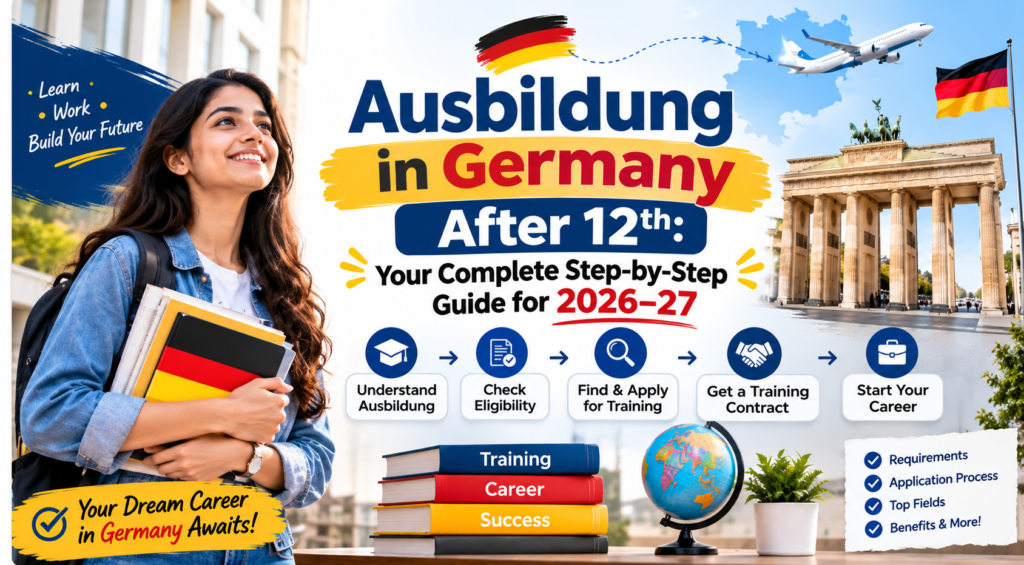
Finished with Class 12 and dreaming of building a global career without getting trapped in endless student loans or a traditional degree? You aren’t alone. Thousands of Indian students are choosing Ausbildung Germany’s renowned dual vocational training system—as a direct, practical gateway to living and working in Europe.
Germany’s renowned dual vocational training program (Ausbildung) combining practical work experience with classroom education, typically lasting between 2 to 3.5 years. Participants earn a monthly stipend while receiving professional training, though mastering the German language is essential for success. For complete guidance on securing an apprenticeship,
Learn more about Ausbildung in Germany.
1. Dual vs. School-Based Training: Which One Fits You?
Germany’s vocational training system is split into two distinct paths:
- Dual Training (Duales Ausbildungssystem): The most popular choice. You split your time between working at a host company (3–4 days a week) to gain hands-on experience and studying at a vocational school (Berufsschule) (1–2 days a week). The best part? You get paid a monthly salary throughout.
- School-Based Training (Schulische Ausbildung): Common in healthcare (such as nursing and physiotherapy), social work, and design trades. Training happens entirely within specialized schools, paired with clinical or practical internships. Stipends here are generally lower or sometimes unpaid depending on the federal state.
2. Who is Eligible? (Academic & Age Requirements)
Your standard Indian Class 12 pass certificate (from CBSE, ICSE, NIOS, or State Boards) meets the minimum academic criteria for most programs.
- Stream Alignment: While diverse backgrounds are accepted, matching your school stream makes your application stronger:
- Science (PCM/PCB): Ideal for Nursing, IT, Mechatronics, and Engineering roles.
- Commerce/Business: Perfect for Logistics, Retail, Banking, and Office Management.
- Arts/Humanities: Great for Hospitality, Tourism, and Customer Service.
- Age Limits: While there is no strict upper age limit for Ausbildung, recruiters generally prefer candidates under 27 years old, and securing a contract above age 27 is very rare.
3. High Demand Ausbildung Courses for Indian Students
Training programs typically run for 2 to 3.5 years. Some of the most sought-after sectors include:
- Nursing & Healthcare (Pflegefachkraft): Immense nationwide demand; comes with great job security and quick placement.
- Information Technology (Fachinformatiker): Focuses on application development or system integration.
- Mechatronics & Industrial Mechanics: Ideal for hands-on, tech-savvy problem solvers.
- Hospitality & Hotel Management (Hotelfachmann/-frau): High demand across major European tourism hubs.
- Logistics & Supply Chain Management: Core to Germany’s massive manufacturing and export economy.
4. Conquering the German Language Barrier
- Because both your workplace training and school classes are conducted entirely in German, language proficiency is non-negotiable. A B2 level in German is now mandatory across all Ausbildung trades. While B1 level was previously accepted for certain fields, that is no longer sufficient.
- Certification Requirement: You must hold an official B2 certificate (from Goethe-Institut, telc, or ÖSD) to qualify for visa processing and vocational training programs.
- Pro Tip: Give yourself 9 to 12 months of dedicated language training in India to comfortably bridge the gap from absolute beginner (A1) to B1/B2 before applying. For online or offline German language learning, you can contact AbroadUp.
5. Finding Employers and Landing a Contract
Securing an apprenticeship (Ausbildungsvertrag) requires a structured, professional approach:
- The German CV (Lebenslauf): Format your CV according to German standards and pair it with a compelling motivation letter (Motivationsschreiben) tailored to each employer.
- Active Job Portals: Check official portals like Make it in Germany, ausbildung.de , the Federal Employment Agency (Bundesagentur für Arbeit), and specialized vocational job boards.
- Interviews: Most initial screenings and technical assessments are conducted online.
- The Contract: Once accepted, you receive an official training contract outlining your monthly stipend, working hours, vacation days, and department rotations.
6. What is the Ausbildung Salary?
By law, every dual training participant receives a regulated monthly training allowance (Mindestausbildungsvergütung) that increases with each year of experience:
- 1st Year: Statutory minimum starts around €724+ per month, though high-demand fields like nursing or mechatronics routinely pay €900 to €1,300+ gross.
- 2nd & 3rd Years: Stipends increase progressively by roughly 18% to 35% as your skills grow.
7. Living Expenses and Financial Proof
- The Living Cost Threshold: The standard monthly financial requirement for visa processing is roughly €1,048 gross (€822 net).
- The Blocked Account Rule: If your training stipend equals or exceeds this threshold, you do not need a blocked account (Sperrkonto) because your salary proves financial self-sufficiency. If your stipend falls short, you only need to bridge the small monthly difference.
8. Visa Process for Indians (Section 16a)
Once you have your signed training contract in hand, you can apply for the German National Visa for Vocational Training (D-Visa) through VFS Global / German Missions in India. Key paperwork includes:
- Valid Indian passport
- Signed Ausbildungsvertrag from your German employer
- Recognized Class 10 and 12 mark sheets (with certified translations if needed)
- Official German language certificate (B1/B2)
- Proof of health insurance
- Completed visa application forms and biometric photos
9. Life After Ausbildung: What Next?
Once you clear your final state examinations, you hold a recognized professional qualification (Ausbildungsabschluss). Your options include:
- Immediate Employment: Transition smoothly into a full-time, permanent job in your trained field.
- Permanent Residency & Citizenship: Working full-time puts you on a clear, streamlined legal path toward long-term residency and eventually a German passport.
Are you currently exploring specific Ausbildung fields like healthcare or IT, or would you like a breakdown of how to start your German language preparation?
Frequently Asked Questions (FAQs)
1. Can I apply for Ausbildung in Germany after completing Class 12 in India?
Yes, Indian students who have completed Class 12 from a recognized board (CBSE, ICSE, NIOS, or State Board) can apply for Ausbildung programs, provided they meet the employer’s requirements.
2. Is German B2 language proficiency mandatory for Ausbildung in Germany?
B2 is recommended or required by many employers and certain training programs. However, the exact language requirement varies by occupation and visa circumstances; B1 may be accepted in some cases.
3. Do Indian students get paid during Ausbildung in Germany?
Yes, students enrolled in dual Ausbildung programs receive a monthly training allowance. The amount depends on the occupation, employer, and year of training.
4. How long does an Ausbildung program take to complete?
Most Ausbildung programs last between 2 and 3.5 years, depending on the profession and training structure.
5. Can I get a job in Germany after completing Ausbildung?
Yes, after successfully completing your final examinations, you can apply for qualified employment in your trained profession. You may also become eligible for long-term residence by meeting Germany’s immigration requirements.