Confused about your eligibility? Get a free profile check in under 2 minutes.
Check My Eligibility →
What are you looking for?
Pick one to get started.
Where & what to study?
Select country and program type.
Which language interests you?
Pick one or more.
Which exam are you preparing for?
Select all that apply.
Which services do you need?
Select all that apply.
Your academic background
Helps us find the best match for you.
How do we reach you?
100% confidential — never shared.
Review & Submit
Everything look good?
Our mentor will contact you within 24 hours.
Check your email for confirmation.
By submitting you agree to our Privacy Policy.
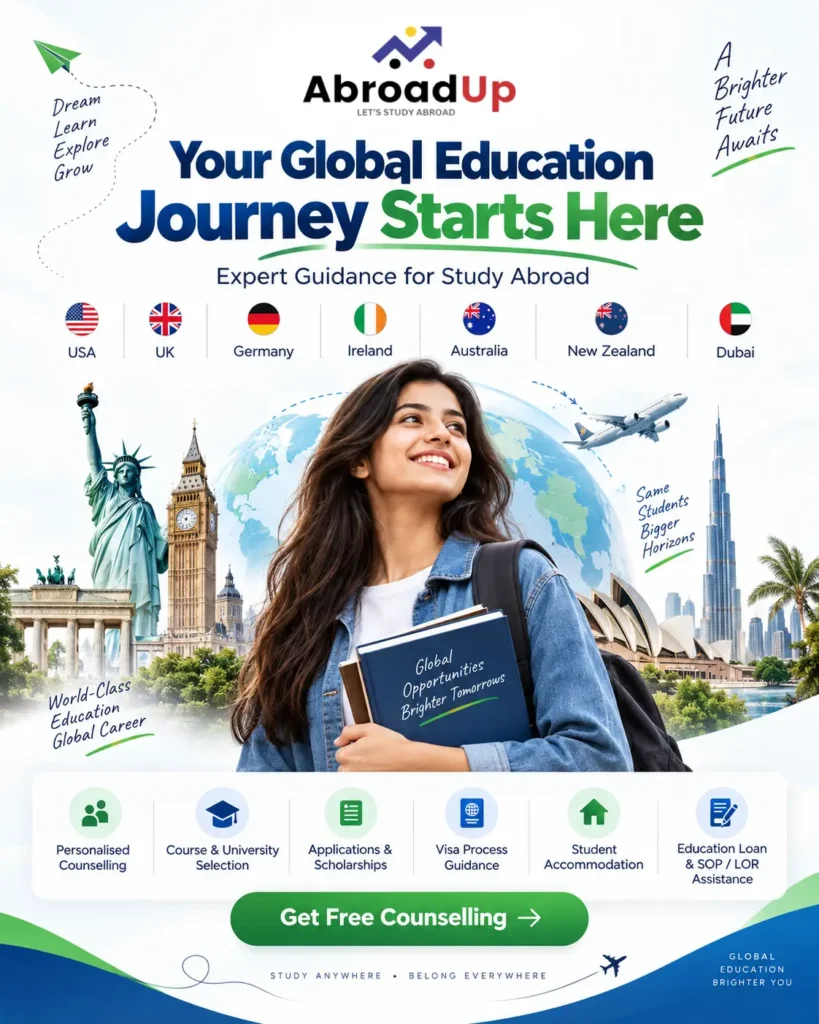
Studying in the UK means enrolling at a British university for a bachelor's degree of three years (four in Scotland) or a master's degree of one year. Indian students apply through UCAS or directly to the university, prove their English, and get a CAS from the university before applying for a Student visa. After graduating, most can stay on the Graduate Route to look for work.
The main draw is time and money. A UK master's takes one year against two in the US, so you pay for one year of tuition and living costs and enter the job market a year earlier. British degrees are recognised by employers worldwide, and the 24 Russell Group universities carry the kind of name that opens doors in India as well.
India and China remain the two biggest sources of international students in the UK. That means you will find large Indian student societies, familiar food and a strong alumni network in almost every university city. If you are still comparing destinations, our page on studying in the UK from Delhi explains how AbroadUp handles UK admissions from shortlisting to visa.
UK courses are shorter and more focused than degrees in India. You choose your subject at the time of applying and there is very little room to change later.
| Level | Duration | Main Intake | How You Apply |
|---|---|---|---|
| Foundation or pathway year | 1 year | September | Directly to the university or pathway provider |
| Bachelor's degree | 3 years (4 in Scotland) | September | UCAS |
| Master's degree | 1 year | September, some in January | Directly to the university |
| PhD | 3 to 4 years | Varies | Directly, usually with a research proposal |
For bachelor's courses, the main UCAS deadline falls in mid-January. Oxford, Cambridge and most medicine, dentistry and veterinary courses close much earlier, in mid-October. Master's admissions are usually rolling, so you can apply earlier and hear back faster, but popular courses fill up before the final deadline.
For a bachelor's degree, most universities accept Class 12 from CBSE, ICSE or a state board, but the marks they expect vary widely. Top universities look for very high scores and strong subject grades, while others offer a foundation year if your marks or subject mix fall short. For a master's degree, you need a relevant bachelor's degree, and universities usually ask for a minimum percentage or a UK-equivalent classification. Some courses also ask for work experience, a portfolio or a GMAT score.
English proof is the other gate. Most universities ask for an overall IELTS Academic score of around 6.0 to 6.5, with higher bands for law, medicine and some management courses. Many also accept PTE, TOEFL, Duolingo or a medium of instruction letter, and some run their own English assessment for visa purposes, so ask the admissions office which route applies to your offer. AbroadUp's IELTS preparation course and our exam preparation team can help you hit the band your target university needs.
| University | Known For | Location |
|---|---|---|
| University of Oxford | Humanities, Sciences, Law | Oxford |
| University of Cambridge | Sciences, Engineering, Maths | Cambridge |
| Imperial College London | Engineering, Medicine, Business | London |
| UCL | Wide range across all fields | London |
| LSE | Economics, Finance, Social Sciences | London |
| University of Edinburgh | Sciences, Informatics, Humanities | Edinburgh |
| University of Manchester | Engineering, Business, Sciences | Manchester |
Rankings matter less than fit. A course with strong industry links and good graduate outcomes at a mid-ranked university often beats a famous name with a weak course for your goals.
The UK is not a low-cost destination. Tuition for most bachelor's and master's courses commonly falls between £15,000 and £30,000 a year, with medicine, dentistry and top MBAs costing much more. On top of tuition, the visa itself has fixed costs, and you must show living funds in your bank account.
| Expense | Approximate Cost |
|---|---|
| Tuition fees | £15,000 to £30,000 or more per year |
| Student visa application fee | £558 |
| Immigration Health Surcharge | £776 per year of visa |
| Proof of funds, London (9 months) | £13,761 (£1,529 per month) |
| Proof of funds, outside London (9 months) | £10,539 (£1,171 per month) |
The proof of funds is on top of any unpaid tuition shown on your CAS. The Home Office has announced higher figures for applications from 30 November 2026, reported as £1,570 a month in London and £1,203 outside it, so check GOV.UK on the day you apply. The money must sit in your account, or your parents' account, for 28 consecutive days, and the last day of that period must fall within 31 days of your application.
If the total looks steep, it is worth comparing routes. Our budget friendly degrees page and our Study Free In Germany guide show lower-cost options, and our Germany destination page explains how they compare.
Scholarships can cover part or all of the tuition, but competition is high. The best known are Chevening (fully funded one-year master's for future leaders), GREAT Scholarships and Commonwealth awards. Most universities also give their own merit awards, often at a fixed amount off the first year's fees. Deadlines usually fall 6 to 12 months before the course starts, so shortlist scholarships at the same time as universities.
Start your UK application the right way, talk to a mentor today.
Book Free Counselling →You can apply up to six months before your course starts, once you hold a CAS. Alongside the CAS you will need your passport, proof of funds, English evidence and academic documents. Because you are applying from India, you also need a tuberculosis test certificate from an approved clinic, and postgraduate applicants in some sensitive subjects need an ATAS certificate before the CAS is issued.
The Home Office has also tightened its checks on whether an applicant is a genuine student, and universities now face stricter limits on visa refusals. In practice, expect a credibility interview and questions about why you chose that course, that university and the UK. Our visa and services team prepares you for that interview and checks every document before filing.
Students on a degree-level course can work up to 20 hours a week during term time and full-time in official vacations. Part-time work helps with daily costs, but do not rely on it to pay tuition, and you may not work as a professional sportsperson or take self-employed work on a Student visa. Most master's students cannot bring dependants to the UK, because only postgraduate research students can, so plan your family arrangements before you apply.
The Graduate Route lets you stay and work, at any skill level, after you complete an eligible UK degree. The length depends on when you apply. Applications made on or before 31 December 2026 receive two years, applications made from 1 January 2027 receive 18 months, and PhD graduates keep three years. This rule is tied to the date you apply, not the date you started your course, so a bachelor's or master's student who joins in 2027 should plan for 18 months.
The Graduate Route does not lead to settlement by itself. The usual next step is a Skilled Worker visa with a sponsoring employer, so use your degree years to build work experience, internships and contacts.
Rules like these change quickly, so treat this page as a guide and confirm the latest position on GOV.UK before you pay any fee.
Not always. Most universities ask for IELTS or an accepted alternative such as PTE, TOEFL or Duolingo, and some accept a medium of instruction letter. Whether you need a Secure English Language Test for the visa depends on the university, so confirm this with your admissions office.
You must show your unpaid first-year tuition plus £1,529 a month for up to nine months if you study in London (£13,761), or £1,171 a month outside London (£10,539). The money must be held for 28 consecutive days. Higher figures apply from 30 November 2026.
It is two years if you apply on or before 31 December 2026, and 18 months if you apply from 1 January 2027. PhD graduates receive three years in both cases.
Yes. Degree-level students can work up to 20 hours a week in term time and full-time during official vacations. Some work types, such as professional sports, are not allowed.
Usually not. Since January 2024 only students on postgraduate research programmes, such as a PhD, and some government-funded scholars can bring dependants. Master's students on taught courses cannot.
Often yes overall, because most UK master's degrees last one year rather than two. That saves a full year of tuition and living costs, although yearly tuition in the UK can still be high.
Not for every course. Many universities admit Class 12 students directly, while others ask for a foundation year if marks or subject combinations fall short of their entry rules. Check the entry page of your specific course.
Takes under a minute · No cost, no obligation


AbroadUp is an innovative study abroad consultancy with its Head Office at Pitampura, Rohini, Delhi. With its “Student First” approach, AbroadUp and its experienced mentors hand-hold and guide students towards diverse range of study abroad programs, curated internships, affordable countries, and global opportunities.
Germany, France, Italy, Austria, Belgium, Bulgaria, Croatia, Cyprus, Czech Republic, Denmark, Finland, Georgia, Greece, Hungary, Latvia, Lithuania, Malta, Netherland, Poland, Portugal, Romania, Spain, Sweden, Swizerland, Russia, Monaco, Norway
UAE/Dubai, Japan, South Korea, China, India, Indonesia, Malaysia, Mauritius, SriLanka, Thailand, Vietnam, Taiwan
Vietnam Tour Package | Vietnam Tour Package in Florida | Vietnam Tour Package in New York | Vietnam Tour Package in California Uzbekistan Tour Package | Uzbekistan Tour Package in Florida | Uzbekistan Tour Package in New York | Uzbekistan Tour Package in California Sri Lanka Tour Package | Sri Lanka Tour Packages in Florida | Sri Lanka Tour Package in New York | Sri Lanka Tour Packages in California Philippines Tour Package | Philippines Tour Package in Florida | Philippines Tour Package in New York | Philippines Tour Package in California Nepal and Bhutan Tour Package | Nepal and Bhutan Tour Package in Florida | Nepal and Bhutan Tour Package in California | Nepal and Bhutan Tour Package in New York Laos Tour Package | Laos Tour Packages in Florida | Laos Tour Packages in California | Laos Tour Package in New York India Tour Package | India Tour Package in California | India Tour Package in Florida | India Tour Package in New YorkBangladesh Tour Package | Bangladesh Tour Package in California | Bangladesh Tour Package in Florida | Bangladesh Tour Package in New YorkAfghanistan Tour Package | Afghanistan Tour Package in California | Afghanistan Tour Package in Florida | Afghanistan Tour Package in New YorkAzerbaijan Tour Package | Azerbaijan Tour Package in Florida | Azerbaijan Tour Package in California | Azerbaijan Tour Package in New York Egypt Tour Package | Egypt Tour Package in New York | Egypt Tour Package in Florida | Egypt Tour Package in California Oman Tour Package | Oman Tour Package in California | Oman Tour Package in New York | Oman Tour Package in FloridaIraq Tour Package | Iraq Tour Package in California | Iraq Tour Package in Florida | Iraq Tour Package in New York Algeria Tour Package | Algeria Tour Package in Florida | Algeria Tour Package in California | Algeria Tour Package in New York
©2026 AbroadUp™ Owned by Skillingua Global Pvt. Ltd.