
Confused about your eligibility? Get a free profile check in under 2 minutes.
Check My Eligibility →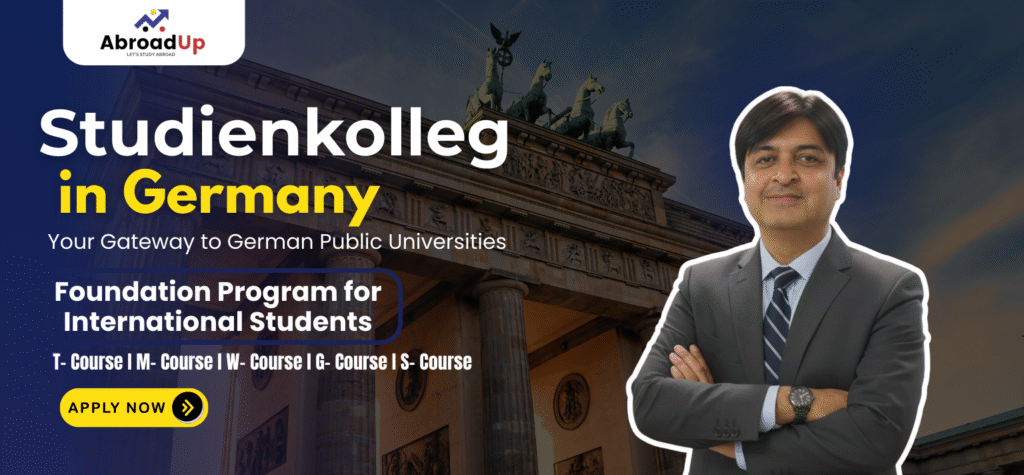
What are you looking for?
Pick one to get started.
Where & what to study?
Select country and program type.
Which language interests you?
Pick one or more.
Which exam are you preparing for?
Select all that apply.
Which services do you need?
Select all that apply.
Your academic background
Helps us find the best match for you.
How do we reach you?
100% confidential — never shared.
Review & Submit
Everything look good?
Our mentor will contact you within 24 hours.
Check your email for confirmation.
By submitting you agree to our Privacy Policy.
Studienkolleg is a one-year preparatory course in Germany for international students whose school certificate does not qualify them for direct entry to a German university. If you have finished Class 12 in India and want a bachelor's degree at a public university, you will most likely have to complete it first. You study German and your subject basics, pass an exam called the Feststellungsprüfung (FSP), and only then apply for your degree.
A Studienkolleg is the bridge between your school certificate and a German degree. German students finish 13 years of school and take the Abitur, which counts as their university entrance qualification (Hochschulzugangsberechtigung, or HZB). Many foreign certificates are not treated as an HZB, so Germany asks you to close that gap inside a Studienkolleg before you start a bachelor's programme.
The course usually runs for two semesters. Classes are held Monday to Friday, often from morning to mid-afternoon, and cover German, mathematics and the subjects linked to your future degree. At the end you sit the FSP. Once you pass, you hold a subject-linked university entrance qualification and can apply to universities across Germany.
There are around 24 public Studienkollegs and roughly 22 private ones. Public institutions are attached to universities and are state funded. Private ones are run by companies or foundations, charge tuition, and differ a lot in quality and recognition. If you are still comparing countries and costs, our Study Free In Germany guide explains why public universities remain the main draw.
In most cases, yes. Indian school education ends at Class 12 after 12 years, while the German Abitur comes after 13. Because of that one-year gap, a Class 12 certificate on its own usually does not give direct access to a German public university. It gives access to a Studienkolleg instead.
You can check your own status in the anabin database, which is maintained by the Central Office for Foreign Education, or in the DAAD admission database. The result falls into one of three groups: direct access, access through a Studienkolleg, or no access yet. Here is how it plays out for most Indian applicants:
Indian applicants also need an APS certificate from the Academic Evaluation Centre at the German Embassy in New Delhi before they can apply. For the winter semester 2026/27 onwards, APS India expects at least 70 percent overall in Class 12 for the Studienkolleg route. Rules like this change often, so confirm the current figure on the APS India website before you build a plan around it.
You do not join a general course. You join a track that matches the degree you want, and your FSP only opens doors in that subject area. Picking the wrong track is one of the most expensive mistakes a student can make, because switching later usually means starting again.
| Course | Meant For | Example Degrees |
|---|---|---|
| T-Kurs | Mathematics, natural science and technical subjects | Engineering, Computer Science, Physics |
| M-Kurs | Medicine, biology and pharmacy | Medicine, Pharmacy, Biotechnology |
| W-Kurs | Business, economics and social science | Business Administration, Economics |
| G-Kurs | Humanities and German studies | History, Literature, German Studies |
| S-Kurs | Language programmes | Modern Languages, Linguistics |
Studienkollegs linked to universities of applied sciences use a different set: TI for technical and engineering degrees, WW for economics, GD for design and arts, and SW for social science. There is one catch here. A Studienkolleg at a university of applied sciences only qualifies you for a university of applied sciences. A Studienkolleg at a university lets you apply to both types.
Availability also varies. The T-course is offered almost everywhere, while the M-course exists at only a small number of locations. Check the course list of each Studienkolleg before you fall in love with a city.
Public Studienkollegs are the default choice for most Indian students because they cost almost nothing and their FSP is state recognised. Private ones exist to fill the gaps, mostly for students who missed public deadlines or want an English-taught track.
| Factor | Public | Private |
|---|---|---|
| Tuition | None, only a semester contribution of about €100 to €400 | Roughly €4,000 and often far higher |
| FSP recognition | State recognised and accepted across Germany | Varies by institution |
| Admission | Competitive, limited seats, entrance exam | Usually easier, with faster start dates |
| Teaching language | German | Mostly German, a few English tracks |
A private Studienkolleg is not a shortcut. Some are state recognised (staatlich anerkannt) and can hold the FSP themselves. Others are only state approved (staatlich genehmigt), which means they can prepare you but cannot issue the certificate, so you would sit the FSP externally. Before you pay a single euro, ask the institution in writing which universities accept its certificate. Some private graduates can only enrol in the same federal state, or even at one partner university.
English-taught options exist, but they are all private. The FH Aachen Freshman Program and CBS Prep4University in Cologne are two examples. They generally qualify you for English-taught degrees or specific partner universities, and the number of English-taught bachelor's programmes at public universities is small, so read the fine print.
Requirements change from one Studienkolleg to another, so treat this as a base list and check the website of your target institution:
Almost every public Studienkolleg teaches in German from the first day. Most ask for B1 when you apply and some ask for B2. By the time of the FSP you are expected to be around B2 to C1, and the course itself trains you up to C1.
Our advice is to reach B1 before you apply and aim for B2 before you fly. Students who arrive with only the bare minimum tend to struggle with maths and science vocabulary in the first two months. AbroadUp's German language courses cover Goethe-Institut levels A1 to C2, so you can build the level you need at home in Delhi and sit the exam before your application deadline. Not sure how long that will take? Our note on how long it takes to learn German in India gives a realistic timeline, and our German language classes in Delhi page shows how to start.
Public Studienkollegs have limited seats, so they run an entrance exam (Aufnahmeprüfung) to select students. It normally includes a German language test and a mathematics paper, and sometimes a subject question in economics or physics. The exam is in German and is often held in person.
The FSP is the final exam at the end of the course. It covers German plus the subjects of your track, with written papers and sometimes an oral part. A few facts every applicant should know:
Our exam preparation team can help with German language tests and TestAS, so your test dates stay in line with your application dates.
The course itself is cheap at a public Studienkolleg. The real spending is living costs and the proof of funds you need for the visa.
| Expense | Approximate Cost |
|---|---|
| Tuition (public Studienkolleg) | €0 |
| Semester contribution (public) | €100 to €400 per semester |
| Tuition (private Studienkolleg) | About €4,000 to €28,000, depending on the institution |
| Health insurance | €1,200 to €1,300 per year |
| Blocked account (proof of funds) | ~€11,904 per year (€992 per month) |
Funding for the Studienkolleg year is thin. DAAD and universities rarely give scholarships for this stage, so most families plan to self-fund it. If cost is the deciding factor, our budget friendly degrees page shows what other affordable routes look like.
Work is allowed on a student residence permit, up to 20 hours a week during the semester. In practice, with classes running until mid-afternoon and heavy homework, most Studienkolleg students manage only a small part-time job.
Start your Studienkolleg application the right way, talk to a mentor today.
Book Free Counselling →Deadlines for Studienkollegs often fall earlier than regular university deadlines. For an October start they usually sit somewhere between January and July, depending on the institution. For an April start they tend to fall between September and January of the previous year. Count backwards from your intake like this:
| When | What to Do |
|---|---|
| 12 months before | Check anabin, start German classes, begin the APS process |
| 6 to 8 months before | Certify and translate documents, apply via uni-assist or directly |
| 3 to 4 months before | Prepare for the entrance exam, collect acceptance, apply for the visa |
| After arrival | Register your address, enrol, activate the blocked account |
Studienkolleg is the most common route, but it is not the only one. TestAS is a one-day aptitude test that costs around €160, and a growing number of universities accept a strong score in place of the Studienkolleg year. Some use it only for bonus points, so always read the admission page of your target university. TestAS suits students who already have solid German and academic preparation. If your German is below B2, the Studienkolleg year gives you the time and structure you need.
If you would rather earn while you learn, dual vocational training does not go through a Studienkolleg at all. Read about Ausbildung in Germany to see whether that path fits your goals.
After you pass the FSP, you apply to universities as an international applicant. You submit your FSP certificate together with your original school certificates. A public FSP is valid across Germany, but many universities favour students who studied in the same federal state, so it helps to pick your Studienkolleg city with your degree in mind.
Most bachelor's programmes then run for three to three and a half years. You can compare universities, intakes and programme structures on our Germany destination page.
A Studienkolleg is a one-year preparatory course for international students whose school certificate is not accepted for direct university entry in Germany. It teaches German and subject basics and ends with the Feststellungsprüfung (FSP), the exam that qualifies you to apply for a bachelor's degree.
Usually yes, if you have only completed Class 12. Indian school education is 12 years and the German Abitur is 13, so Class 12 alone does not give direct access. Students who finish one year of a recognised Indian bachelor's degree may qualify for direct subject-restricted admission instead.
Public Studienkollegs charge no tuition. You only pay a semester contribution of roughly €100 to €400. Private Studienkollegs charge fees that start around €4,000 and can go much higher, and their certificates are not always accepted everywhere.
Most courses last two semesters, which is about one academic year. Very strong students can sometimes finish in one semester. If you fail a semester or the FSP, you can repeat it once, which adds another semester.
Most Studienkollegs ask for B1 German at the time of application, and some ask for B2. You are expected to reach roughly B2 to C1 by the time you take the FSP.
Public Studienkollegs teach in German. A few private institutions, such as the FH Aachen Freshman Program and CBS Prep4University, offer English tracks, but they usually qualify you only for English-taught degrees or partner universities.
You can retake the FSP once, normally at the same Studienkolleg after an additional semester. A second failure usually means you cannot continue on the Studienkolleg route at that institution.
Takes under a minute · No cost, no obligation

AbroadUp is an innovative study abroad consultancy with its Head Office at Pitampura, Rohini, Delhi. With its “Student First” approach, AbroadUp and its experienced mentors hand-hold and guide students towards diverse range of study abroad programs, curated internships, affordable countries, and global opportunities.
Germany, France, Italy, Austria, Belgium, Bulgaria, Croatia, Cyprus, Czech Republic, Denmark, Finland, Georgia, Greece, Hungary, Latvia, Lithuania, Malta, Netherland, Poland, Portugal, Romania, Spain, Sweden, Swizerland, Russia, Monaco, Norway
UAE/Dubai, Japan, South Korea, China, India, Indonesia, Malaysia, Mauritius, SriLanka, Thailand, Vietnam, Taiwan
Vietnam Tour Package | Vietnam Tour Package in Florida | Vietnam Tour Package in New York | Vietnam Tour Package in California Uzbekistan Tour Package | Uzbekistan Tour Package in Florida | Uzbekistan Tour Package in New York | Uzbekistan Tour Package in California Sri Lanka Tour Package | Sri Lanka Tour Packages in Florida | Sri Lanka Tour Package in New York | Sri Lanka Tour Packages in California Philippines Tour Package | Philippines Tour Package in Florida | Philippines Tour Package in New York | Philippines Tour Package in California Nepal and Bhutan Tour Package | Nepal and Bhutan Tour Package in Florida | Nepal and Bhutan Tour Package in California | Nepal and Bhutan Tour Package in New York Laos Tour Package | Laos Tour Packages in Florida | Laos Tour Packages in California | Laos Tour Package in New York India Tour Package | India Tour Package in California | India Tour Package in Florida | India Tour Package in New YorkBangladesh Tour Package | Bangladesh Tour Package in California | Bangladesh Tour Package in Florida | Bangladesh Tour Package in New YorkAfghanistan Tour Package | Afghanistan Tour Package in California | Afghanistan Tour Package in Florida | Afghanistan Tour Package in New YorkAzerbaijan Tour Package | Azerbaijan Tour Package in Florida | Azerbaijan Tour Package in California | Azerbaijan Tour Package in New York Egypt Tour Package | Egypt Tour Package in New York | Egypt Tour Package in Florida | Egypt Tour Package in California Oman Tour Package | Oman Tour Package in California | Oman Tour Package in New York | Oman Tour Package in FloridaIraq Tour Package | Iraq Tour Package in California | Iraq Tour Package in Florida | Iraq Tour Package in New York Algeria Tour Package | Algeria Tour Package in Florida | Algeria Tour Package in California | Algeria Tour Package in New York
©2026 AbroadUp™ Owned by Skillingua Global Pvt. Ltd.